
The industrial coatings sector is undergoing rapid evolution driven by technological innovation, sustainability and the need to improve the performance of industrial processes. By 2026, these factors will be decisive for sectors such as automotive, energy, metallurgy and manufacturing.
At Mestres Pintura Industrial, we continuously analyse trends in industrial painting and surface treatments to offer durable, efficient solutions adapted to new technical and regulatory challenges.
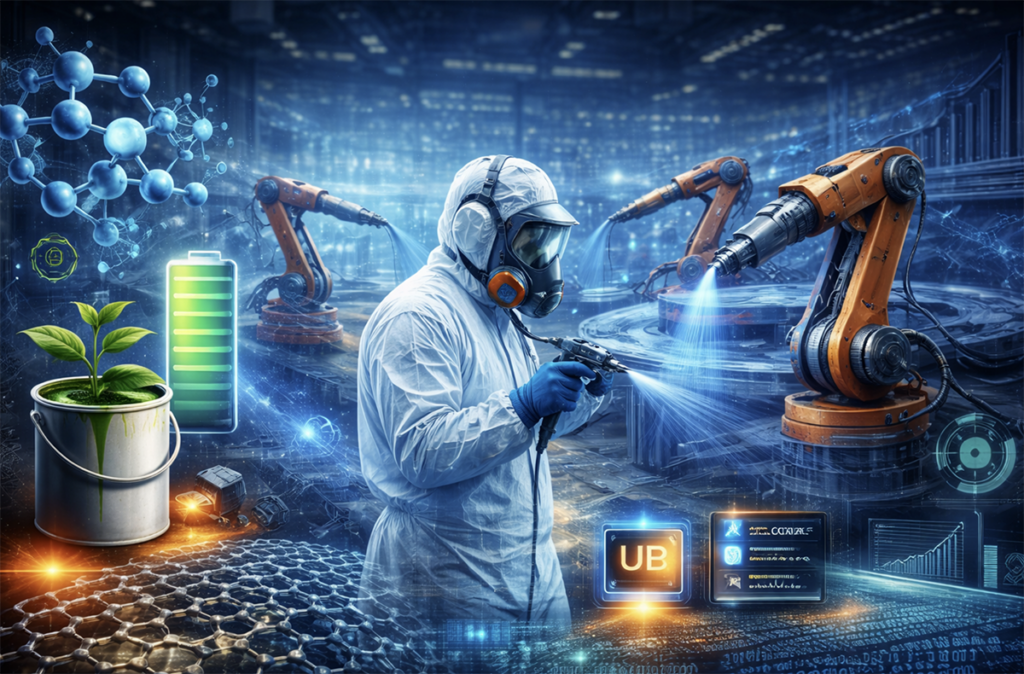
Sustainability in industrial coatings: less impact, greater efficiency
Sustainability has become one of the main drivers of change in the industrial painting sector. The adoption of low-VOC (Volatile Organic Compounds) coatings, bio-based resins and water-based formulations is already a priority for many industries.
This progress is not driven solely by regulatory compliance. Increasingly, the environmental impact of the entire coating life cycle is taken into account, from manufacturing to durability and maintenance. In this context, fast-curing systems such as UV curing or electron beam curing stand out, as they reduce energy consumption and optimise production times.
Choosing sustainable industrial coatings makes it possible to reduce pollutant emissions, improve process energy efficiency and move towards more responsible and competitive production models.
Smart coatings and nanotechnology applied to industrial painting
Nanotechnology applied to industrial coatings is redefining the performance of technical paints. The incorporation of nanoparticles improves mechanical resistance, substrate adhesion and protection against corrosion and chemical agents.
One of the most promising developments is self-healing coatings, capable of autonomously sealing microcracks, preventing minor damage from developing into structural failures. At the same time, so-called smart paints can detect corrosion, moisture or wear, enabling more efficient industrial maintenance management.
These technologies help extend the service life of facilities and machinery, reducing maintenance costs and unplanned downtime.
Digitalisation and automation in industrial painting processes
Industry 4.0 is already a reality in the industrial painting sector. The integration of robots and automated application systems ensures greater precision, repeatability and coating uniformity.
Digital control systems and real-time inspection allow critical parameters such as layer thickness and finish quality to be monitored during the process itself, detecting deviations immediately. In addition, the use of digital twins (virtual replicas of the process or the real coating that allow behaviour to be simulated before physical application) facilitates parameter adjustment, paint consumption optimisation and error reduction before entering production.
The combination of automation, digital control and virtual simulation will lead to more efficient, sustainable industrial painting processes with more consistent final quality.
The future of industrial coatings in 2026
The year 2026 will mark a turning point in the industrial coatings and industrial painting sector. The combination of sustainability, digitalisation and advanced materials is redefining standards of quality, efficiency and durability in industrial processes.
The adoption of more environmentally friendly coatings, together with digital control technologies and advanced simulation, will enable companies to optimise resources, reduce environmental impact and improve the performance of their facilities. At the same time, the development of new materials and smart systems will open the door to more durable solutions, with lower maintenance requirements and greater long-term reliability.
In this context, the ability to anticipate, innovate and adapt to these changes will be key to addressing the technical and regulatory challenges of the coming years. Industrial coatings will cease to be a passive element and will become a strategic component of performance, efficiency and sustainability in production processes.