
In industrial painting, what you cannot see matters too.
Coating thickness is one of the most important factors determining paint performance, yet it is also one of the most underestimated.
A coating system may be correctly selected, but if it is not applied at the appropriate thickness, its performance can be compromised.
What is paint thickness and why is it so important?
Thickness refers to the amount of material applied to a surface, usually measured in microns. This parameter determines the coating’s ability to act as a barrier against external factors such as moisture, corrosion, and abrasion.
Insufficient thickness leaves the surface exposed.
Excessive thickness can lead to surface defects and adhesion problems.
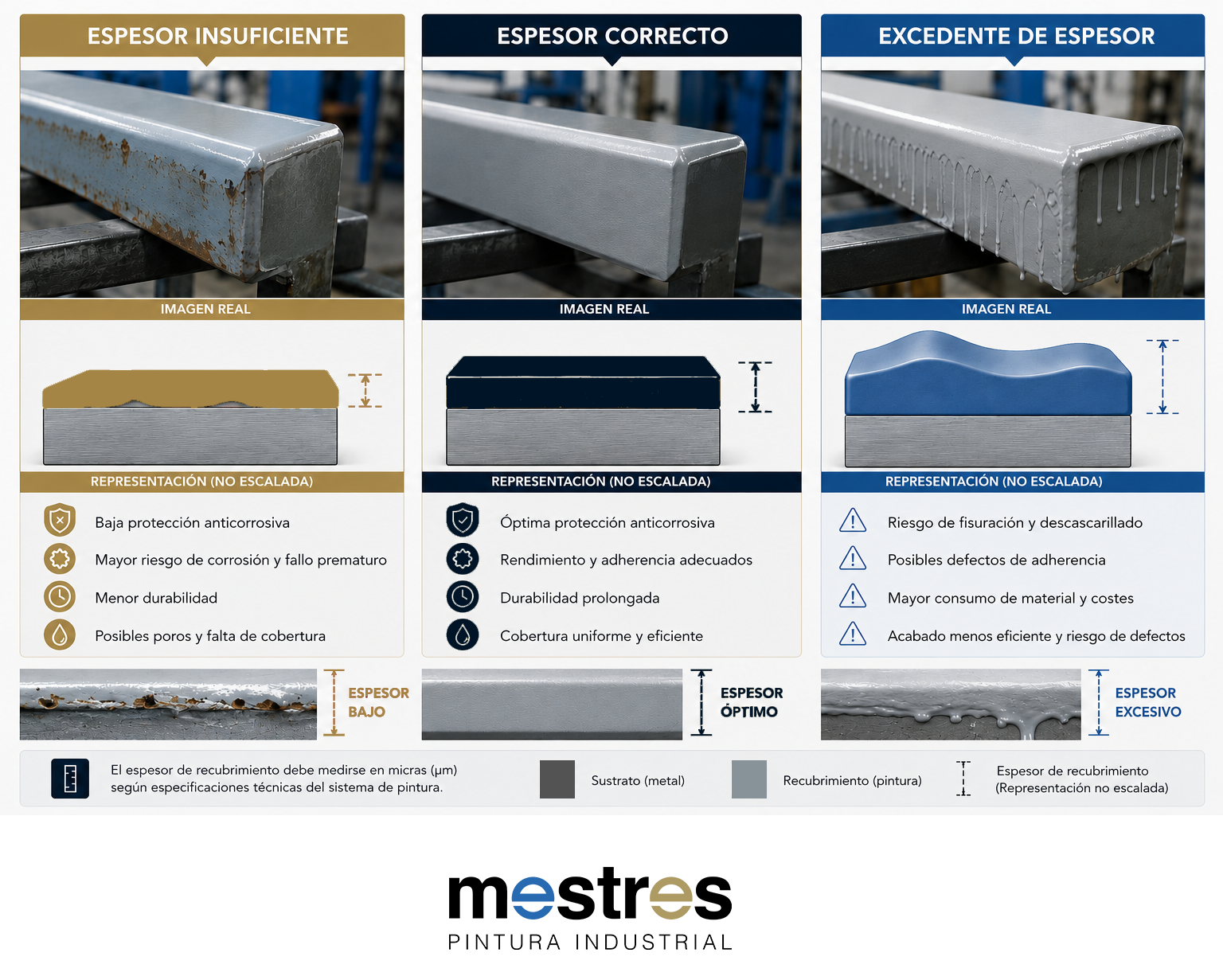
Insufficient thickness: when protection falls short
Applying less material than required is one of the most common mistakes in industrial painting.
It can lead to:
- Premature corrosion
- Reduced resistance to wear
- A significant reduction in service life
- Uneven coating thickness
In these cases, the coating system loses its protective capacity much sooner than expected.
Excessive thickness: more is not always better
Although it may seem otherwise, applying more paint than necessary can also cause problems.
These include:
- Risk of runs, sagging, or surface defects
- Internal stresses within the coating
- Potential loss of adhesion
- Loss of mechanical properties
Excess material does not necessarily improve protection; instead, it can compromise the coating’s overall performance.
How is the appropriate thickness determined?
The optimal thickness is not standard, as it depends on multiple factors:
- Type of coating system
- Environmental conditions
- Mechanical requirements
- Applicable regulations and standards
- Expected durability
For this reason, each coating system is defined by a specific thickness range that must be precisely maintained.
Thickness control: a key part of the process
Ensuring the appropriate thickness requires monitoring throughout the entire application process.
This involves:
- Specific measuring equipment
- Inspections during and after painting
- Rigorous quality control
- Qualified technical personnel
Without this level of control, even a well-designed coating system can fail.
At Mestres Pintura Industrial, we use specific technologies such as CoatMaster, a system that enables precise, non-contact measurement and monitoring of coating thickness.
This technology makes it possible to verify thickness during the process, detect potential deviations, and ensure a more uniform and controlled application. In this way, we can strengthen quality control, optimize the application process, and ensure that the coating meets the required technical specifications.
Because when it comes to industrial painting, measurement is also an essential part of ensuring quality and durability.
Thickness as a key factor in durability
The performance of an industrial coating does not depend solely on the product used, but also on how it is applied.
Thickness is a critical variable that directly influences:
- Corrosion resistance
- System durability
- Resistance to wear
- Maintenance requirements
In industrial painting, details make the difference.
Coating thickness is one of those invisible factors that determine whether a system will perform correctly over time. That is why, beyond choosing the right product, ensuring precise and controlled application is essential.
At Mestres Pintura Industrial, we approach every project with this level of attention and precision because we know that quality does not depend on a single factor, but on the combination of all of them.